
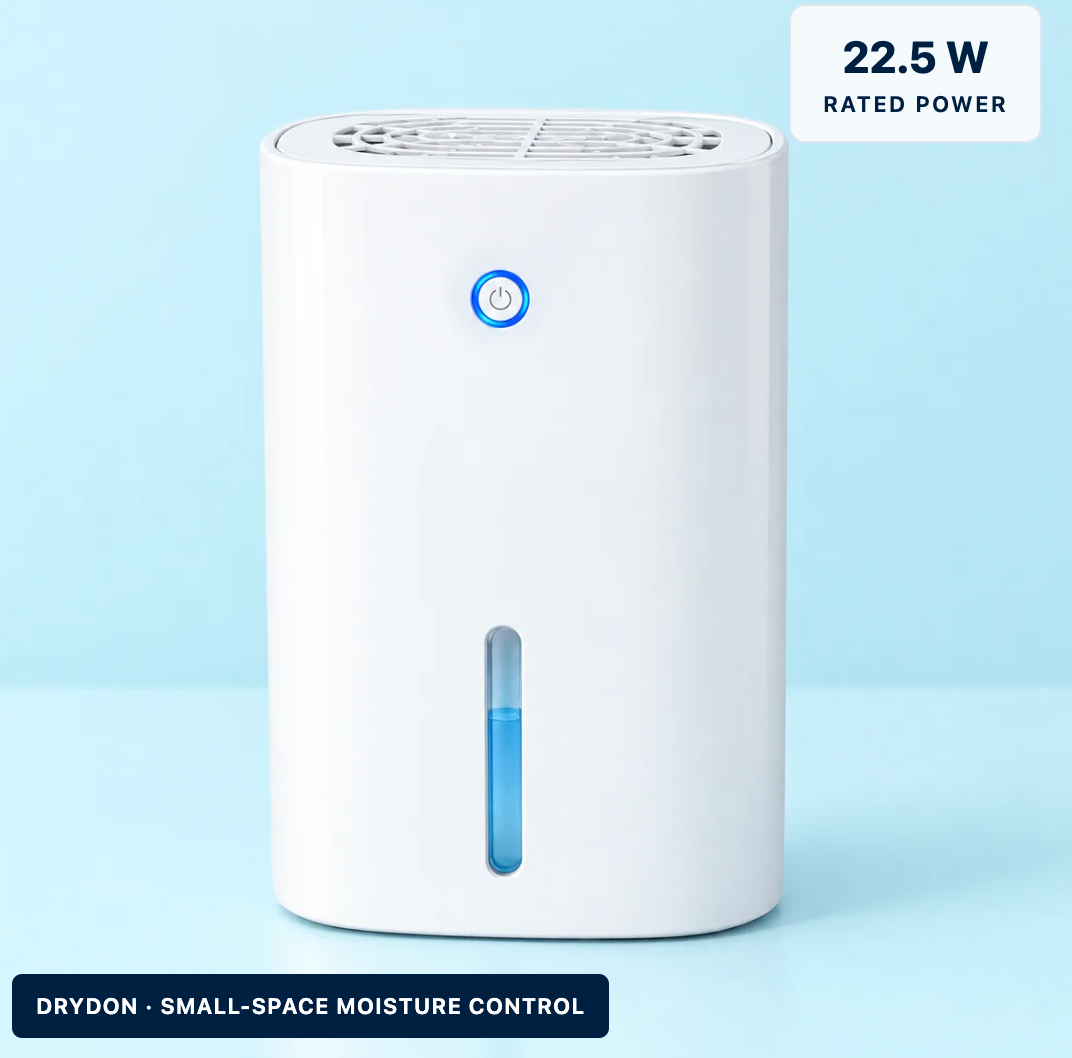
Drydon Compact Dehumidifier
Drydon collects excess moisture in small spaces, with one-button operation and just 22.5 W rated power.
- Low rated power. Check your running costs below.
- Collect, empty, reuse. A removable 1,000 mL tank.
- Better bundle value. Keep a unit in each small space.
Description
Excess humidity can make a room feel uncomfortable, contribute to condensation, and create a damp or musty environment. The problem can become particularly noticeable in smaller spaces such as bedrooms, bathrooms, closets, studies, and storage areas. A compact dehumidifier can be a convenient way to collect some of that excess moisture without installing a large appliance.
Drydon Compact Dehumidifier is designed specifically around this small-space use case. According to the manufacturer’s website, Drydon combines a compact design with one-button operation, a removable 1,000 mL water tank, automatic shut-off when the tank is full, and a rated power consumption of 22.5 watts. The manufacturer lists extraction of up to 350 mL per day under specific test conditions of 86°F and 80% relative humidity.
But is Drydon suitable for your home? What does it actually offer, how does it work, where should it be used, and what should buyers know before ordering?
Let’s take a closer look.
What Is Drydon Compact Dehumidifier?
Drydon is a small-space moisture-control appliance designed to collect excess water from the surrounding air. Instead of using disposable moisture-absorbing packs, the device collects water in a reusable tank that can be removed, emptied, and placed back into the unit.
The concept is straightforward: place Drydon in an appropriate small room or enclosed space, connect the supplied adapter, press the power button, and allow the appliance to collect moisture.
The manufacturer’s website describes it as a product intended for spaces such as bedrooms, closets, bathrooms, and studies rather than as a whole-home dehumidification system. It specifically cautions that large open rooms, heavy moisture loads, cold spaces, and persistent damp may require a different solution.
This distinction is important because a compact dehumidifier isn’t necessarily designed to replace a full-size compressor dehumidifier.
How Does Drydon Work?
Drydon is designed around a simple collect-and-empty routine.
As the appliance operates, moisture from the surrounding air is collected inside its removable reservoir. The water level can be viewed through the front window, allowing users to see when the tank needs attention.
Once the tank reaches its capacity, the manufacturer says Drydon automatically stops and the indicator flashes. You can then switch the unit off, remove the tank, empty it, replace it correctly, and restart the device.
The result is a relatively simple maintenance routine:
Place → Plug in → Press → Collect → Empty → Reuse
There are no complicated controls or multiple settings to learn.
Key Drydon Features
1. Compact Design
One of Drydon’s main advantages is its compact approach. Instead of occupying the floor space associated with a larger dehumidifier, it is intended for everyday placement in smaller spaces.
This makes the concept particularly suitable for people who want localized moisture control rather than trying to manage the humidity of an entire house with one large machine.
2. 22.5-Watt Rated Power
Drydon is listed with a rated power consumption of 22.5 watts per unit.
The official website provides an example calculation using one unit operating for eight hours per day at an electricity rate of $0.20 per kWh. Under those illustrative assumptions, it estimates approximately $1.08 over 30 days.
Of course, electricity prices differ considerably by location, and actual consumption can vary. Therefore, the example should be treated as an illustration rather than a guaranteed electricity cost.
3. 1,000 mL Removable Tank
The appliance includes a 1,000 mL removable water tank.
The tank’s capacity should not be confused with the amount of water Drydon removes per day. The manufacturer separately lists extraction of up to 350 mL per day under specified test conditions.
The transparent or visible water-level area makes it easier to determine when the tank needs emptying.
4. Automatic Full-Tank Stop
One useful convenience feature is automatic stopping when the water tank becomes full.
According to the manufacturer, the indicator flashes when the tank needs to be emptied. This means users don’t have to continuously watch the appliance while it is operating.
5. One-Button Operation
Drydon keeps operation deliberately simple.
Rather than providing a complicated control panel, the device uses a single on/off button. For users who prefer appliances that don’t require extensive configuration, this can make everyday operation easier.
6. Manufacturer-Listed 36 dB Sound Level
Drydon’s manufacturer lists a sound level of 36 dB. However, the product page appropriately notes that perceived sound can vary according to placement, room acoustics, and measurement conditions. Because the unit contains a fan, it should not be considered completely silent.
7. Reusable Water Collection
Unlike disposable moisture absorbers that require replacement packs, Drydon uses a reusable water tank.
Once the tank is emptied, it can be returned to the appliance and used again.
This creates a straightforward recurring routine without requiring users to continually purchase replacement moisture-absorbing cartridges.
Drydon Benefits
Helps Manage Excess Moisture
The primary purpose of Drydon is to collect excess moisture from the air in small spaces.
If a bedroom, closet, bathroom, or study frequently feels humid, a compact dehumidifier may help make the environment feel more comfortable.
Useful for Small Spaces
Drydon is specifically positioned for smaller areas. The manufacturer’s recommended applications include small rooms and spaces such as studies, walk-in closets, and bathrooms.
Easy to Operate
With one-button operation, there isn’t a lengthy setup procedure. Users simply place the unit correctly, connect the adapter, and switch it on.
Easy Water-Level Monitoring
The visible water-level window makes it possible to check the reservoir without complicated indicators or guesswork.
Automatic Shut-Off
The automatic full-tank stop adds another layer of convenience because the unit stops when the reservoir requires emptying.
Low Rated Power
At 22.5 watts, Drydon has relatively low rated power consumption compared with many larger dehumidification appliances. Actual energy costs depend on operating hours, electricity rates, and real-world consumption.
No Disposable Absorber Packs
The reusable water tank means the product does not rely on disposable moisture-absorber refill packs, according to the manufacturer’s website.
Where Can You Use Drydon?
Drydon’s small-space design makes it potentially useful in several areas of a home.
Bedroom
A bedroom can sometimes feel humid or clammy, particularly when ventilation is limited. A compact moisture-control appliance can be placed in an appropriate location while leaving the vents unobstructed.
Closet
Closets can be particularly vulnerable to stagnant air and moisture because they are enclosed.
Drydon can be placed on a suitable dry shelf or surface to provide localized moisture collection.
Bathroom
Bathrooms naturally experience increased humidity because of showers and hot water.
The manufacturer recommends keeping Drydon on a dry, stable surface and away from splashes. Proper bathroom ventilation should still be used.
Home Office or Study
Small offices and studies may also benefit from localized humidity control, especially when windows remain closed for extended periods.
How to Use Drydon
Using Drydon is relatively straightforward.
Step 1: Choose the Location
Place the unit upright on a stable, dry surface.
Make sure air inlets and outlets aren’t blocked.
Step 2: Insert the Tank
Ensure the removable water tank is correctly installed before operating the appliance.
Step 3: Connect the Adapter
Connect the supplied power adapter according to the manufacturer’s instructions.
Step 4: Press the Power Button
Press the single on/off button to begin operation.
Step 5: Monitor the Tank
Check the water-level window periodically.
Step 6: Empty the Tank
When the tank becomes full and the indicator flashes, switch off the appliance, remove the tank, empty it, replace it properly, and restart the unit.
How Much Moisture Can Drydon Remove?
The manufacturer lists an extraction figure of up to 350 mL per day at 86°F and 80% relative humidity. However, this is an important number to interpret correctly.
It is a specific test-condition figure, not a guarantee that every user will collect 350 mL every day.
Actual moisture collection can vary depending on:
- Room temperature
- Relative humidity
- Room size
- Ventilation
- Placement
- Operating time
- Moisture sources in the room
The official product page explicitly notes that everyday results can differ from the stated test-condition figure.
Is Drydon Suitable for an Entire House?
This is one of the most important considerations before purchasing.
Drydon is designed for small spaces rather than whole-home humidity control.
If you have a large living room, an open-plan house, severe dampness, significant water intrusion, or a persistent moisture problem, a larger-capacity dehumidifier may be more appropriate.
The manufacturer itself states that large spaces and persistent damp may require different equipment, improved ventilation, or repairs to the source of the moisture.
Therefore, buyers should choose the appliance according to the size and severity of the moisture problem.
Can Drydon Remove Mold?
Drydon should not be considered a mold-removal product.
Reducing excessive humidity may be part of managing an environment where moisture contributes to mold growth, but an appliance cannot repair a leaking pipe, fix water intrusion, or clean existing mold.
If mold is already present, the underlying moisture source should be addressed and appropriate cleaning or professional remediation considered.
The manufacturer specifically explains that Drydon collects moisture from the air but does not repair leaks or clean existing mold.
Drydon Price
The official Drydon page currently lists the single-unit offer at $79.95. It also advertises multi-unit bundles.
The listed offers include:
- 1 unit: $79.95
- 2 units: $124.99
- 3 units: $159.99
- 4 units: $189.99
- 5 units: $219.99
The three-unit package is listed at approximately $53.33 per unit, while the five-unit package works out to approximately $44 per unit. The page says final price, shipping, taxes, and availability are confirmed at checkout.
Prices can change, so buyers should check the current offer before ordering.
Why Consider Multiple Drydon Units?
The multi-unit concept is based on room-by-room use.
For example, instead of carrying one appliance from a bedroom to a closet and then to a bathroom, a homeowner could keep separate units in different small spaces.
This can be convenient when multiple enclosed areas have independent moisture concerns.
However, buying more units doesn’t turn Drydon into a whole-house dehumidification system. The manufacturer’s own guidance emphasizes that bundles are intended for separate small spaces rather than whole-home coverage.
Drydon Reviews: What Should You Know?
The Drydon website includes several review-style sections. However, there is an important disclosure: the page identifies these as sample review drafts with AI-generated people and photos, not customer testimonials.
Therefore, prospective buyers should not treat those sample reviews as independent customer experiences.
This is worth highlighting because genuine customer reviews should ideally come from verified purchasers or independent review platforms.
Drydon Pros and Cons
Pros
- Compact design
- Designed for small spaces
- One-button operation
- Removable 1,000 mL tank
- Automatic full-tank shut-off
- Visible water-level window
- 22.5 W rated power
- Reusable water collection
- Manufacturer-listed 36 dB sound level
- Multi-unit bundles available
- Advertised 30-day money-back guarantee
Cons
- Intended for small spaces rather than whole-home use
- Extraction depends heavily on environmental conditions
- The 350 mL/day figure is based on specific test conditions
- Not a mold-removal device
- Not suitable as a solution for leaks or serious water intrusion
- Actual sound perception can vary
- Bundle purchases mean additional electricity consumption
Who Should Consider Drydon?
Drydon may make sense for someone who has a relatively small space where excess humidity is an ongoing annoyance and wants a simple appliance rather than a large dehumidifier.
It may be worth considering for:
- Small bedrooms
- Walk-in closets
- Bathrooms
- Home offices
- Studies
- Small enclosed rooms
- Localized moisture-control needs
It may be less appropriate for:
- Large living rooms
- Open-plan homes
- Basements with serious damp
- Rooms affected by major water leaks
- Whole-home humidity control
- Severe or persistent mold problems
Final Verdict: Is Drydon Worth Considering?
Drydon Compact Dehumidifier takes a straightforward approach to moisture control. Its biggest selling points are its compact format, simple one-button operation, reusable 1,000 mL tank, automatic full-tank shut-off, and low 22.5 W rated power.
The product is best understood as a small-space dehumidifier, not a high-capacity whole-home machine. That distinction is important when deciding whether it fits your needs.
If your main concern is a bedroom, closet, bathroom, study, or another relatively small space, Drydon’s compact design may be convenient. The ability to place individual units in separate spaces can also be useful for people who don’t want to continually move one appliance around.
At the same time, expectations should remain realistic. The advertised extraction rate of up to 350 mL per day is measured under specific conditions, and actual collection will depend on temperature, humidity, ventilation, room size, and operating time.
Anyone dealing with persistent dampness should also investigate the underlying cause. Better ventilation, leak repairs, and appropriately sized dehumidification equipment may be necessary.
Overall, Drydon is most interesting for consumers looking for a simple, compact way to manage excess moisture in smaller enclosed spaces. Before ordering, compare the current price, return terms, room requirements, and your expected humidity problem to determine whether a compact unit is the right solution.
Reviews
There are no reviews yet.